In the rich and complex histories of North America, the United States and Canada stand as symbols of ambition, resilience, and possibility. Yet beneath the surface of their prosperity lies an unsettling truth: legacies of inequality, displacement, and systemic injustice continue to shape the lives of millions. These nations, though divergent in their beginnings, now find themselves grappling with echoes of similar struggles, demanding a reckoning with their pasts and a commitment to building fairer futures.
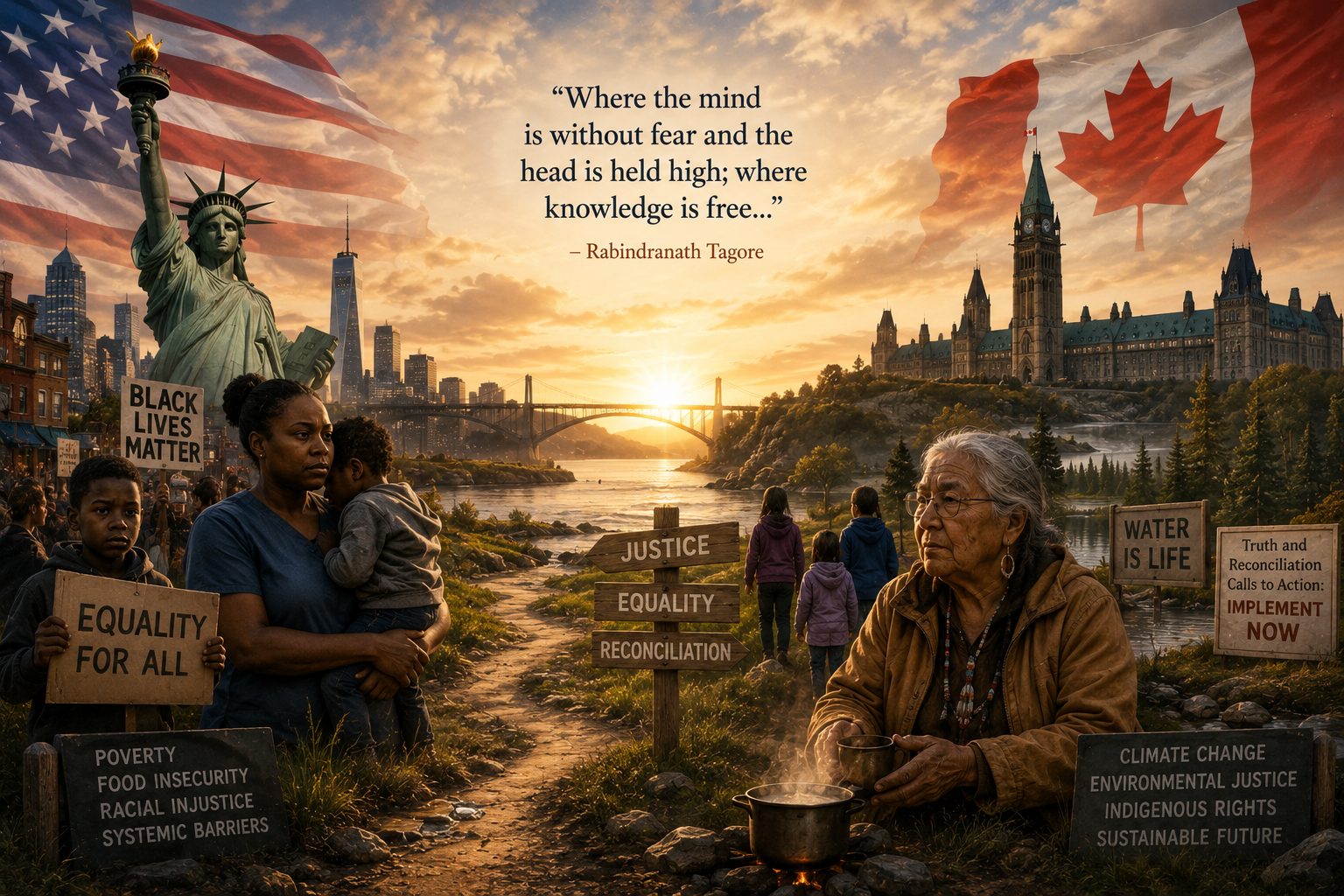
Rabindranath Tagore, in his Gitanjali, dreamt of a world “where the mind is without fear and the head is held high; where knowledge is free.” Though written in the context of colonial India, Tagore’s vision transcends time and place. It speaks to universal human striving for dignity, equality, and justice. Today, his prayer resonates across the Americas, urging nations like the United States and Canada to confront their contradictions and fulfill their vast potential.
The United States declared independence in 1776 with lofty ideals of liberty and equality but entrenched slavery and dispossession in its fabric.
Its wealth, now unrivaled with a GDP of $26 trillion, remains concentrated in the hands of the few, while systemic barriers keep millions in poverty. Nearly 37 million Americans face food insecurity, and for those living on the margins, like the mother in Detroit juggling multiple jobs and medical bills, the “American Dream” feels more like an unreachable mirage.
Canada, often seen as the gentler neighbour, celebrates its multicultural ethos and universal healthcare. Yet its founding compromises excluded Indigenous peoples, whose land was taken and whose children were sent to residential schools designed to erase their identity. Today, over 30 Indigenous communities still live under boil-water advisories, a grim reminder that reconciliation remains an unfulfilled promise. For a Cree elder in Saskatchewan boiling water for her family, the country’s glowing international reputation rings hollow.
Both nations continue to grapple with systemic inequities. In the United States, movements like Black Lives Matter have illuminated how deeply racism is entrenched in institutions like policing, housing, and voting. Canada, while less polarized, faces a quieter reckoning with its colonial history. The Truth and Reconciliation Commission laid bare the atrocities of residential schools, but its calls to action remain only partially implemented. For those affected, like a survivor who lost their language and family in the system, progress feels painfully slow.
The shared crisis of climate change underscores the urgency of action. The wildfires that darkened the skies over New York and Toronto in 2023 are not isolated events; they are warnings. Despite their wealth and resources, both nations falter in addressing environmental degradation. Canada, a leading oil producer, walks a tightrope between economic dependence and green commitments, while the United States remains the world’s second-largest carbon emitter. Indigenous communities, like the Wet’suwet’en in British Columbia and the Standing Rock Sioux in North Dakota, have led the fight to protect their lands, showing what true stewardship looks like.
Despite these challenges, there are glimpses of hope. Canada’s Indigenous Guardians programs empower First Nations to lead environmental protection efforts, blending traditional knowledge with modern science. In the United States, grassroots movements like the Navajo Water Project are delivering clean water to those left behind by systemic neglect. These initiatives remind us that change is possible when communities are centered in solutions.
Tagore’s plea for a world “where tireless striving stretches its arms towards perfection” challenges us to do better. For the United States, this means addressing the glaring inequalities in healthcare, education, and wealth distribution. For Canada, it means turning symbolic gestures into tangible progress for Indigenous communities. Both nations must lead boldly on climate action, prioritizing the planet over profit.
As individuals, we too hold power. Supporting organizations like Soul Fire Farm, which combats food insecurity in marginalized communities, or advocating for Indigenous-led climate initiatives, are tangible steps toward a fairer future. We can amplify voices that demand accountability and ensure leaders prioritize human dignity over political expediency.
Imagine a North America where no child in Flint has to drink poisoned water, where no family in Nunavut has to boil water to survive, and where every community, regardless of wealth or race, has access to clean air, safe housing, and equal opportunity. These are not lofty dreams. They are the bare minimum that such wealthy nations should provide.
Tagore wrote of a world where the “clear stream of reason” guides progress, free from the “dreary desert sand of dead habit.” Let us honour his vision by demanding more from our leaders and ourselves. For the failures of the United States and Canada are not theirs alone; they belong to all of us. And their success would be a shared hope for the rest of us, too.