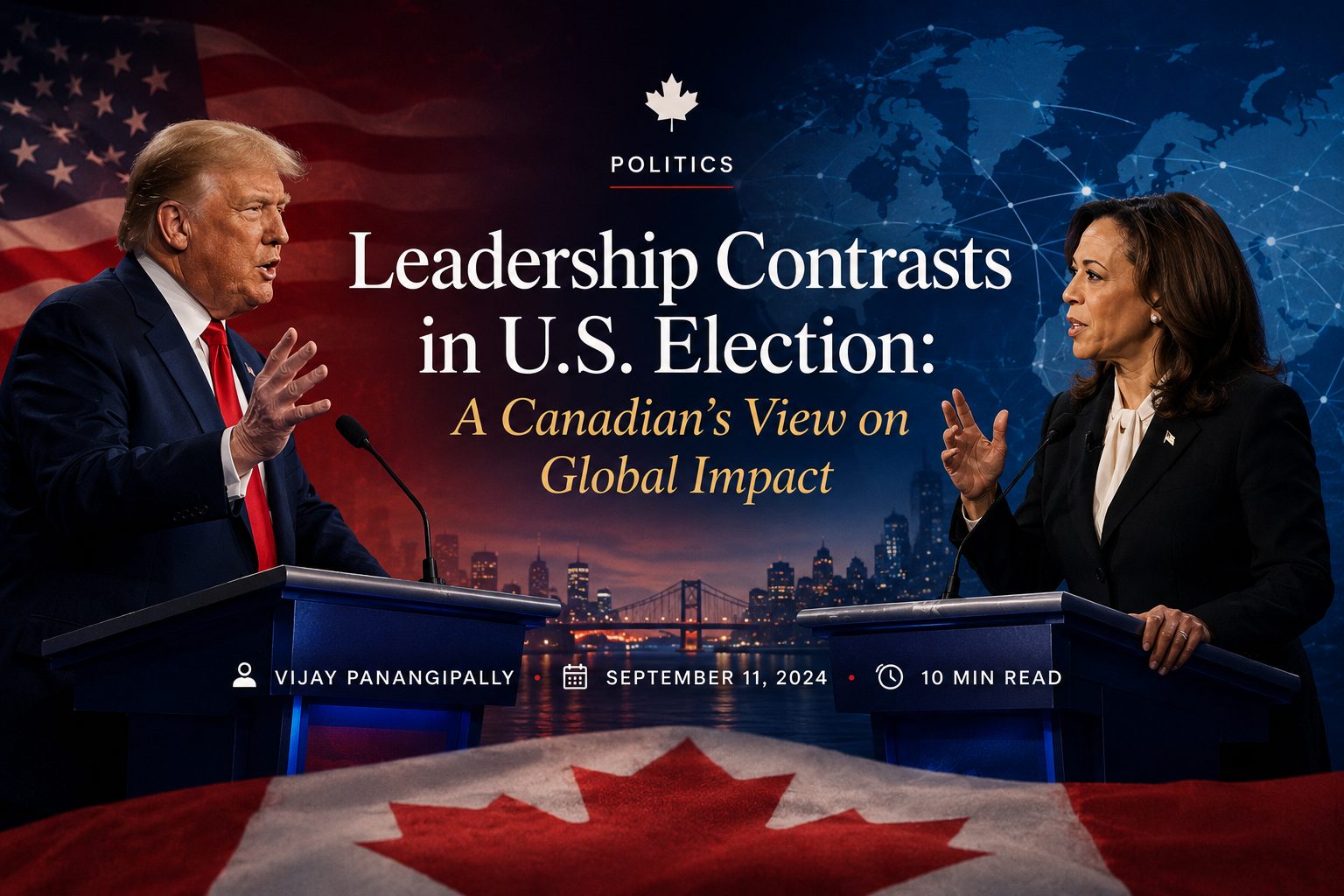
As a Canadian watching the U.S. presidential debate between Donald Trump and Kamala Harris, I’ll admit, I hesitated to form any strong opinions. After all, as someone from outside the United States, I worry about being seen as yet another entitled liberal with unsolicited thoughts on a country that I’m not a part of. I don’t want to sound as though I’m inserting myself into conversations that Americans are rightly having among themselves, particularly about the future of their own nation.
Yet, as I sat there, quietly contemplating the stakes of this debate, I couldn’t shake the feeling that this is bigger than just the U.S. Election Day. The choices Americans make in this moment won’t just affect their own future; they will ripple across the world. For example, decisions on climate policy directly impact global efforts to combat climate change, an issue that Canada, like many other nations, is deeply invested in. Canada has felt the impact of Trump’s withdrawal from the Paris Climate Agreement firsthand. We share environmental challenges like Arctic warming, and collective action is crucial. And as I watched, I felt a sense of deep concern. Not in a detached, academic way, but with genuine care for the people of America and for the global consequences of their election.
So, with humility and respect, I decided to share my thoughts, not because I believe I have the ultimate perspective on the U.S., but because the well-being of America matters for the well-being of us all. I speak from a place of concern for the common good, for unity, and for a future that we all share on this fragile planet.
A Global Leadership That Speaks Beyond Borders
What stood out most to me during the debate was the profound contrast between Donald Trump and Kamala Harris, not just in their policies, but in their vision of leadership itself. Leadership in today’s world is more than making bold declarations or commanding authority. It’s about how a leader connects with people and how they recognize the interdependence that defines our global society.
Donald Trump, ever the strongman, laid out a vision of leadership that is fiercely self-reliant and unapologetically nationalistic. His “America First” philosophy centers on economic independence and control, and it is clear that he believes the U.S. can rise above its challenges by going it alone. His foreign policy, characterized by trade wars and tariffs, focuses on protecting American industries, like manufacturing and energy exports, from foreign competition. And for many, his message of strength and economic revival strikes a chord.
But from where I stand, as a Canadian who values collaboration and partnership, this approach feels isolating. We live in an age where no country, no matter how powerful, can truly thrive in isolation. The challenges we face, whether it’s the global economy, climate change, or social justice, are shared challenges. Take the case of the North American Free Trade Agreement (NAFTA), now renegotiated into the USMCA. While Trump’s tariff-heavy policies were aimed at benefiting American workers, the uncertainty it caused in industries like agriculture and manufacturing was felt throughout Canada as well. Cooperation, not isolation, strengthens both our nations. Trump’s decision to pull out of the Paris Climate Agreement sent shockwaves through the world, because it signaled a retreat from the collective fight against a crisis that affects us all.
On the other hand, Kamala Harris presented a vision of leadership grounded in empathy, inclusion, and a profound recognition that the world is stronger when we stand together. Her promise to re-enter the Paris Agreement and rebuild the relationships with America’s global allies struck a deep chord with me. This isn’t just a political promise; it’s a commitment to the future of humanity. The challenges we face today, whether environmental or social, require more than just national strength. They require global solidarity. Harris’s focus on collective solutions and rebuilding trust between nations is a vision that speaks to the kind of leadership our interconnected world so desperately needs.
A Global Economy and the U.S.’s Role in It
America’s economic power has always been a force to be reckoned with. The largest and most diverse economy in the world, the U.S. draws its wealth from a broad range of industries: technology, energy, finance, pharmaceuticals, and agriculture, to name a few. These industries don’t just fuel America’s prosperity; they play a crucial role in the global economy, shaping markets and policies worldwide.
Donald Trump’s approach to foreign policy and trade reflects his belief that protecting these industries from foreign competition is the key to America’s success. His tariffs and renegotiated trade deals are designed to bring jobs back to the U.S., and there’s no denying that this appeals to many American workers. However, the impact of these policies has been felt far beyond U.S. borders. As a Canadian, I’ve seen firsthand how his “America First” stance has strained our trade relations, particularly in industries like steel and aluminum, where tariffs have created uncertainty and tension.
For example, Canada’s steel industry, which exports about 90% of its production to the U.S., was thrown into turmoil by these tariffs. What started as a move to protect American jobs ended up causing significant economic damage to Canadian workers, showing how interconnected our economies truly are.
Kamala Harris, in contrast, understands that the U.S.’s economic success is deeply tied to its relationships with other nations. Her vision of re-entering multilateral agreements and embracing global cooperation feels like a breath of fresh air. America is at its best when it leads with both strength and humility, recognizing that global economic prosperity isn’t a zero-sum game. It’s not about winning at the expense of others; it’s about building a future where all nations rise together. Harris’s emphasis on clean energy and sustainability also points to a future where the economy can grow without sacrificing the health of our planet, a future that I, like many Canadians, deeply hope to see.
Fundamental Human Rights: The Heart of True Leadership
Leadership is not just about policies and numbers; it’s about people. It’s about the dignity, rights, and opportunities every person deserves, no matter where they come from or what they look like. And in this debate, the contrast between Donald Trump and Kamala Harris on the issue of human rights was stark.
Trump’s stance on immigration, healthcare, and law enforcement has been a defining aspect of his presidency. His administration has taken a hardline approach to immigration, focusing on securing borders and enforcing strict control. To his supporters, this is a necessary defence of national sovereignty. But for many, including myself, this approach raises serious concerns about compassion, fairness, and humanity. The images of families separated at the border and the hardline stance against refugees are difficult to reconcile with the values of human dignity that so many of us hold dear.
Kamala Harris, on the other hand, represents a leadership built on empathy and justice. Her advocacy for criminal justice reform, her unwavering support for healthcare as a human right, and her recognition of the systemic inequalities faced by marginalized communities are the kind of leadership that seeks to uplift, not suppress. Her focus on inclusivity, equity, and justice for all aligns deeply with the values of compassion and fairness that we hold close here in Canada.
For Harris, human rights aren’t just a talking point; they are the foundation of a just and thriving society. Her vision of America is one where healthcare, justice, and opportunity are accessible to all, where the nation’s strength is measured not by its wealth or power, but by how it treats its most vulnerable citizens. As I watched her speak, I felt a sense of hope for a future where empathy guides policy, and where the world is a better place for everyone, not just a select few.
Two Visions for the Future: A World of Strength or a World of Unity
Both Trump and Harris offered competing visions for America’s future, and each vision has its own merits. Trump’s vision of America is one rooted in economic strength, self-reliance, and bold leadership. He sees America as a fortress: strong, independent, and unafraid to protect its own interests. His focus on deregulation, tax cuts, and energy independence speaks to a desire for immediate economic prosperity, even if it comes at the cost of long-term global relationships.
But as a Canadian, I see a different kind of future. A future where strength is not just about power, but about collaboration and unity. Kamala Harris’s vision of America is one where the country leads with empathy and inclusivity, working hand-in-hand with other nations to solve the challenges that face all of us, whether it’s climate change, social justice, or economic inequality. Harris represents a future where America steps forward not as a solitary giant, but as a compassionate leader, ready to unite the world in the pursuit of a brighter tomorrow.
Empathy: The Heartbeat of True Leadership
If there is one quality that defines Kamala Harris’s leadership, it’s empathy. Watching her in the debate, I was struck by how deeply she connects with the struggles of everyday people, whether it’s the families devastated by COVID-19, the communities grappling with racial injustice, or the workers who can’t afford healthcare. Harris doesn’t just talk about policies; she talks about people. She sees their pain, their hopes, and their dreams. And that is the kind of leadership that transcends borders.
Donald Trump, by contrast, projects strength and resilience, qualities that many find reassuring in turbulent times. His focus on law and order, economic recovery, and national pride appeals to those who want to feel secure when so much feels out of control. But leadership is not just about strength; it’s about connection. It’s about understanding that a nation’s true greatness lies not in its ability to stand alone. Instead, it lies in its ability to lift others up.
Hope for a Brighter Future
As a Canadian, I watched this debate not just as an observer, but as someone who is deeply connected to the future of our shared world. The U.S. is at a crossroads. The path it chooses will shape its own destiny. It will also shape the destiny of the entire planet. Donald Trump offers a vision rooted in strength and self-reliance. Kamala Harris presents a vision of empathy and global cooperation.
What I hope for, more than anything, is a future where these qualities come together. I envision a future where strength is guided by compassion. I also envision a future where America leads not by turning inward, but by embracing the world with open arms. The challenges we face are too great for any one country to solve alone. We need leaders who see beyond borders and who understand that our fates are intertwined.
No matter the outcome of this election, my hope is that the U.S. emerges stronger. It becomes more united and more committed to leading with empathy and justice. The vision for a future includes all of us. As a neighbour, I wish our American friends the very best in this critical moment. The decisions made in the U.S. will ripple across the globe, touching every corner of our shared world. Whether through economic strength or compassionate leadership, I hope the next chapter of U.S. history is one of healing, unity, and progress, for all of humanity.
As someone who has long worked in global business, I’ve seen firsthand how interconnected our economies and societies are. The U.S. election feels especially significant because it will shape not only the future of one nation but the world we all share. That’s why I’ve felt compelled to offer this perspective, with hope and goodwill for our southern neighbors. I write it from a Canadian vantage point, conscious that it is only one view among many, and that it is through such differing perspectives that we come to understand the world we hold in common.