In August 1947, the British Empire relinquished its hold over South Asia, carving out two nations from the subcontinent: India and Pakistan. It was a moment of liberation, but also of rupture. Partition uprooted 15 million people, leaving over a million dead. It wasn’t just a division of territory but a severance of communities, homes, and hearts. The border, hastily drawn across the map, became a wound, bleeding stories of loss, resilience, and hope.
A Hindu woman in Lahore clutched her children and memories as she fled to Delhi. A Muslim farmer in Punjab left the fields his family had tilled for generations to seek refuge in a new homeland called Pakistan. A Sikh trader in Amritsar watched his bustling town change overnight, its communal spirit engulfed by the flames of mistrust. These were not just migrations; they were exiles. Each carried the weight of a history they could no longer inhabit.
Seventy-six years later, what remains of the promises made in 1947? India’s leaders vowed to create a secular democracy where diversity would not divide but strengthen. Pakistan’s founders envisioned a homeland for Muslims where justice and equality would reign. These were lofty ideals, noble in aspiration but fraught in execution. The trajectories of these nations, born of the same moment but shaped by divergent paths, reflect both their triumphs and their betrayals.
India today is the world’s fifth-largest economy, with a GDP of $3.7 trillion and annual growth rates of 6-7%. Its journey from a socialist-inspired economy to a global powerhouse in technology, pharmaceuticals, and space exploration is a testament to its resilience and ambition. Yet, beneath its skyscrapers lies another India, where over 200 million people live below the poverty line, and wealth inequality widens with each passing day. Ten percent of its population controls nearly 77% of the nation’s wealth, a disparity that mocks its democratic ideals.
Pakistan, too, has had its share of resilience, but its story has been one of unfulfilled potential. With a GDP of $376 billion and growth rates hovering around 1-2%, it struggles under the weight of external debt and recurring economic crises. Projects like the China-Pakistan Economic Corridor (CPEC) have provided a lifeline, but the benefits often fail to reach ordinary citizens. In the textile mills of Faisalabad, a worker earning less than $2 a day wonders if prosperity will ever touch his life.
Both nations have made strides in education and healthcare, but disparities persist. India’s literacy rate of 77% reflects its investment in universal education programs, yet rural schools remain understaffed and underfunded. Pakistan lags with a literacy rate of 59%, its education system stretched thin and struggling to serve its growing youth population. In healthcare, the contrast is stark: India boasts a life expectancy of 70 years compared to Pakistan’s 67, yet rural areas in both countries face inadequate access to doctors and facilities. Malnutrition affects nearly 38% of Pakistani children under five, a haunting statistic mirrored by India’s own challenges with child hunger.
Malnutrition plagues 38% of children under five, a grim reminder of systemic neglect. However, initiatives like Ehsaas, a social safety net program, have offered some hope to the poorest families. Take 14-year-old Arifa in rural Sindh, whose school lacks books but not spirit. Her dream of becoming a doctor mirrors that of millions across the subcontinent, children who hunger for more than just food. They hunger for opportunity.
The cultural fabric of these nations tells a more complex story. India’s secular identity, once its greatest strength, is now strained by rising Hindu nationalism. Minorities feel increasingly alienated, questioning whether the pluralism promised in the Constitution still holds. Pakistan, built on the foundations of Islamic unity, has often sidelined its non-Muslim minorities, subjecting them to systemic discrimination and legal vulnerabilities. Yet, in the bazaars of Karachi and the gullies of Mumbai, in the poetry of Lahore and the films of Bollywood, the shared cultural heritage of these nations refuses to be silenced.
What would Faiz Ahmed Faiz or Mahatma Gandhi think of their homelands today? Would they see fulfillment or betrayal of the dreams they championed? The struggles of a Dalit farmer in Bihar or a Christian teacher in Sindh echo the same universal cry for dignity and opportunity. Their stories remind us that the boundaries drawn in 1947 divide land but not humanity.
The challenges these nations face are immense, but they are not theirs alone. A stable, prosperous South Asia is critical for global peace and economic stability. India’s leaders must reaffirm their commitment to secularism and inclusivity, while Pakistan’s leadership must embrace diversity as a strength rather than a challenge. Both nations must prioritize education, health, and social equity, dismantling the systems that tether their most vulnerable citizens to cycles of poverty and marginalization.
The international community, too, has a role to play. These nations do not exist in isolation. Engage with them as partners, not critics. Support trade, invest in grassroots development, and hold governments accountable, not out of charity but out of shared humanity. When millions of children in South Asia go to bed hungry each night, it is not just a failure of policy; it is a stain on the world’s conscience.
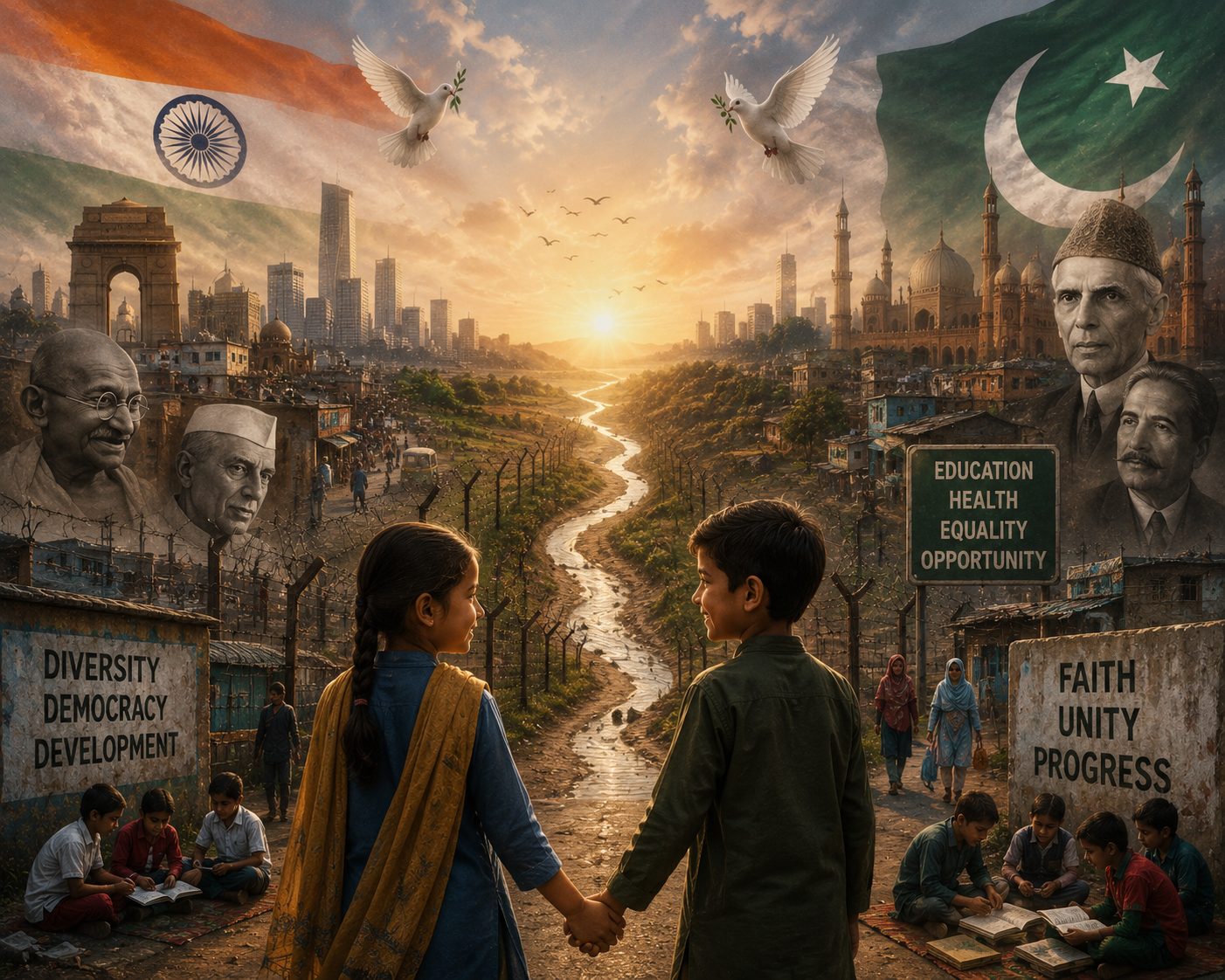
Imagine a future where a girl in Delhi and a boy in Karachi can meet, not as strangers divided by history, but as inheritors of a shared dream. A South Asia where borders are respected but no longer define relationships. A region that draws strength not from its divisions but from its shared history and aspirations.
Seventy-six years ago, these nations were born in the shadow of partition but with the light of hope. That light has not died; it flickers in every child who dares to dream of a better tomorrow, in every worker who labours for a brighter future. Let us honour those dreams with more than reflection. Let us honour them with action. Their stories are ours, and in their futures sits our hope.