I have written about Apple’s artificial intelligence twice on this blog, and if I am honest, both pieces were a little bit love letters. I wanted the technology to be good. I wanted the small computer I carry everywhere, the one that holds my photos and my half-finished thoughts and my late-night messages to the people I love, to feel like it was finally on my side.
So twice I let myself hope, and twice, in different ways, I was wrong.
In October 2024, when Apple Intelligence first arrived in iOS 18.1, I welcomed it as something modest but real: an assistant that had finally stopped performing and started helping. In March 2025, I looked ahead to the smarter, more personal Siri that Apple kept teasing, and I let the hope get the better of me, even as I wrote, almost as a hedge against my own excitement, that Apple “has a long history of promising more than it ships on day one.” Of everything in those two pieces, that guarded little sentence is the one that aged best. I wish it had not.
Because what came next was not the assistant. It was a delay. A long, public, faintly humiliating one, the kind that makes you feel a little foolish for having believed the keynote. And now, more than two years after that first shining demo, the iOS 27 public beta has arrived carrying a version of Siri that, at last, does the things we were promised. So this is the third piece. The reckoning. The one where I finally get to ask the only question that ever mattered: was the wait worth it?
I think it was. And I did not expect to be the one saying so.
Two promises in 2024, and only one of them real
Apple made two promises in 2024, and it is worth being tender with the fact that it kept only one of them on time.
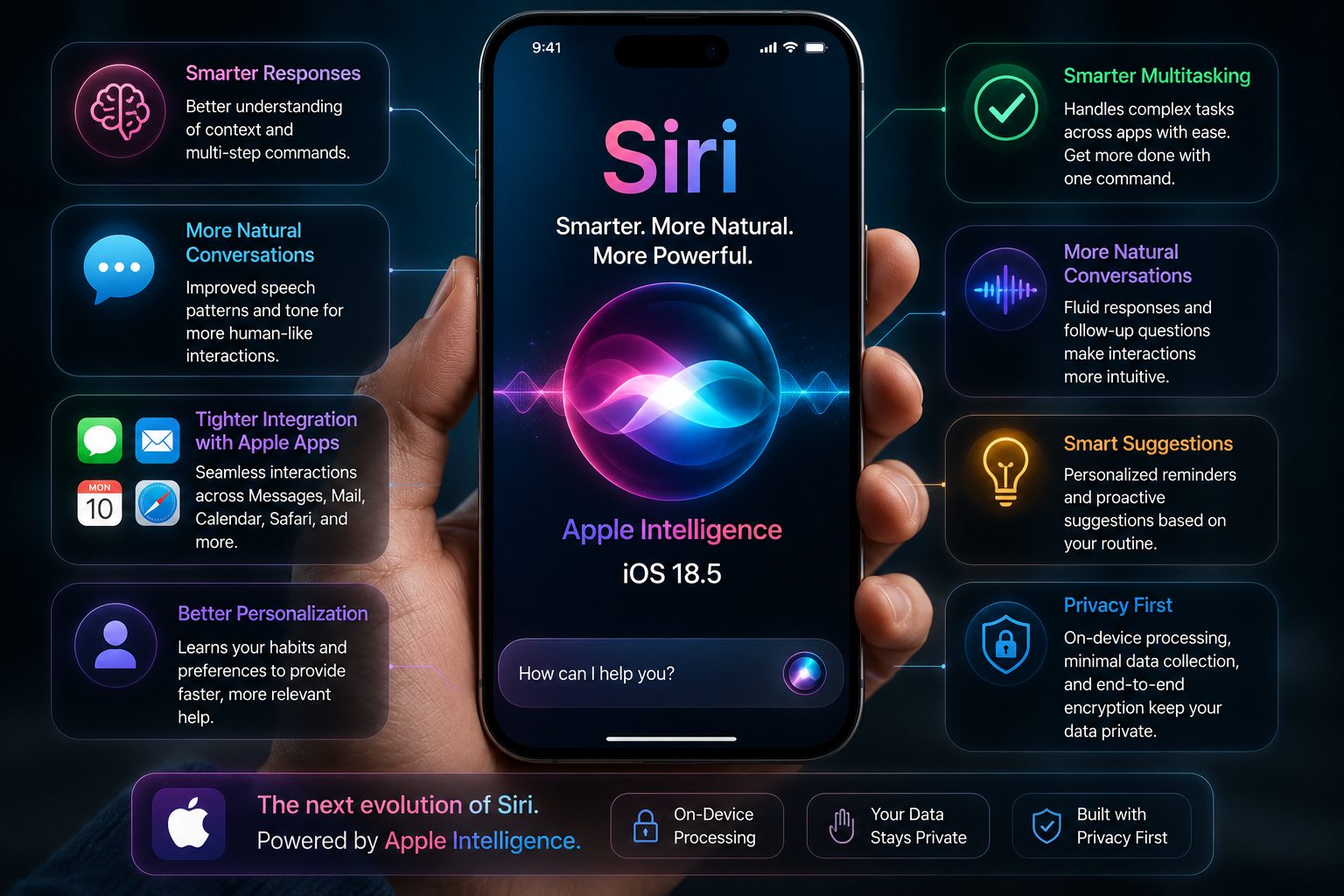
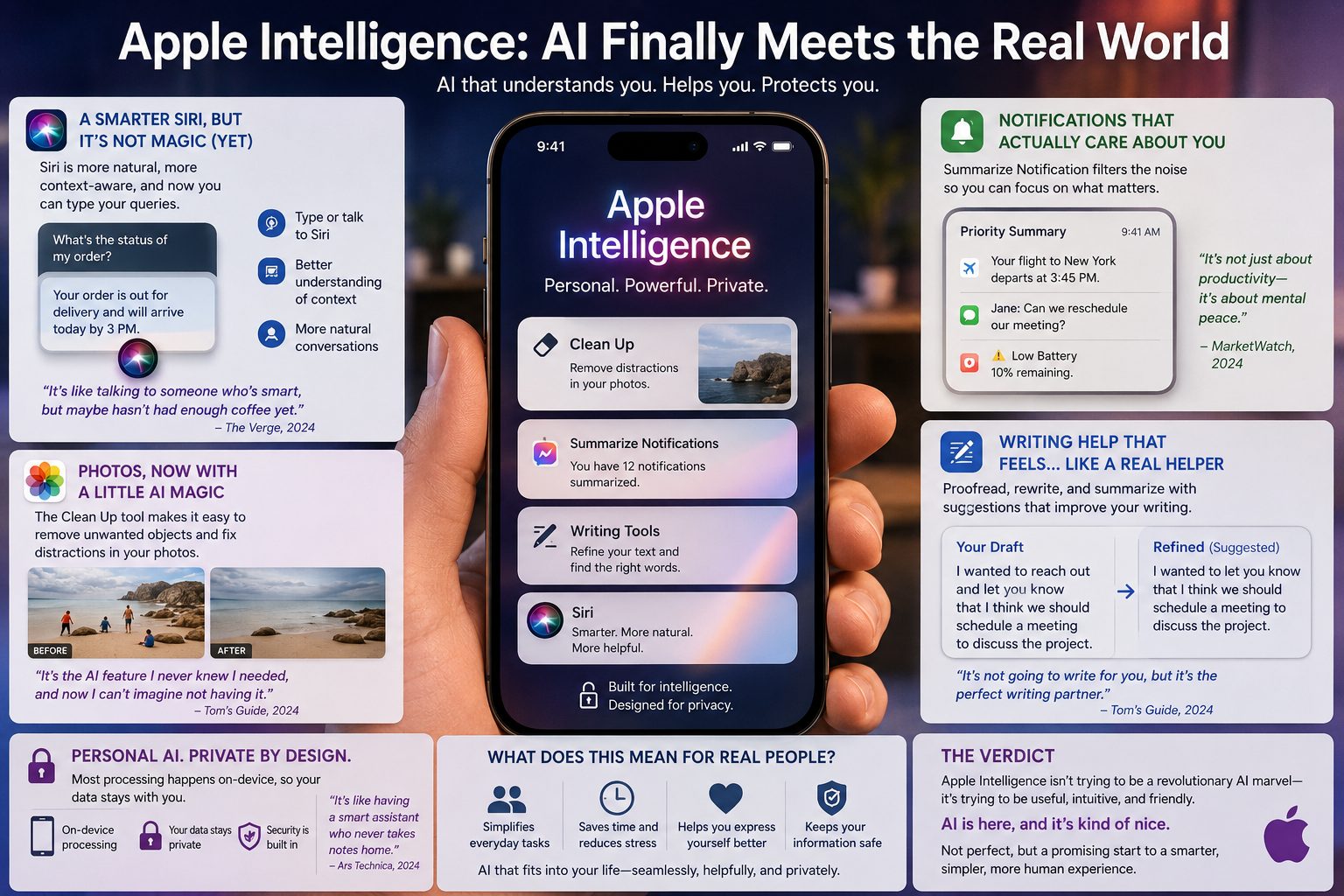
The first was Apple Intelligence itself, which shipped in iOS 18.1 that October. That one was real, and I lived with it, and I loved it in the quiet way you love things that just make your day lighter. It was not the science-fiction assistant the keynotes hinted at. It was smaller, and somehow more human for being small: notification summaries that let me put the phone down with a clearer conscience, a Clean Up tool in Photos that erased the stranger from the edge of a family picture, writing suggestions that read my clumsy late-night sentences back to me a little kinder than I had written them. You could finally type to Siri instead of talking to it, which sounds like nothing until you are the person hiding in a meeting, whispering into a phone like it is a secret. I called it AI that was “kind of nice,” and I meant it as the highest sort of praise. It asked for nothing and gave a little. That is rarer than it sounds.
The second promise was the one my heart actually leaned toward. At its 2024 developer conference, Apple showed a Siri that could see what was on your screen, that knew your context, your messages, your mail, your calendar, and could reach across your apps and simply do the thing. Apple believed in it enough to sell iPhone 16s on it. And I believed in it too. That was the Siri I was writing toward in March 2025: the one that would finally feel less like a search box that talks back and more like someone paying attention.
That Siri did not come. Not that spring. Not that year. And I felt the specific, slightly silly ache of having hoped out loud.
The lost year
In March 2025, Apple admitted the personal Siri needed more time and pushed it into 2026. The reasons were about quality: the features were not reliable enough, and rather than patch them, the company tore up the foundation and rebuilt it. In plain language, the thing worked in a demo and fell apart in a life, and Apple, to its genuine credit, refused to ship the demo.
To its discredit, it had already sold the demo to people like me. Some had bought iPhone 16s on the strength of features that were not there, and their frustration was fair, and I understood it in my body, because I had spent good money and better hope on the same story. This is the part I want to sit with, because it is the tender centre of the whole thing. A demo is a promise made in a perfect room. A shipped feature is a promise kept in the mess of a real day, with your real accent, your real inbox, your real bad signal on a moving train. The distance between those two is exactly where trust lives or dies, and for most of 2025 Apple stood in that gap with empty hands, while the rest of us stood there feeling a little bit taken.
I felt it more sharply than I probably should have, because I had written it down. I had put my cautious hope on the page, and the page does not forget. The lesson, the one I keep having to learn the hard way, is that you cannot review a promise. You can only review a thing. My March 2025 piece was, in the end, a love letter to something that did not exist yet, and love letters to the not-yet-real have a way of embarrassing you later.
What Apple actually shipped while we waited
Here is the part that got buried under the frustration, and that I have come to feel real affection for: Apple did not spend the wait sulking. It spent it quietly shipping the unglamorous half of the dream.
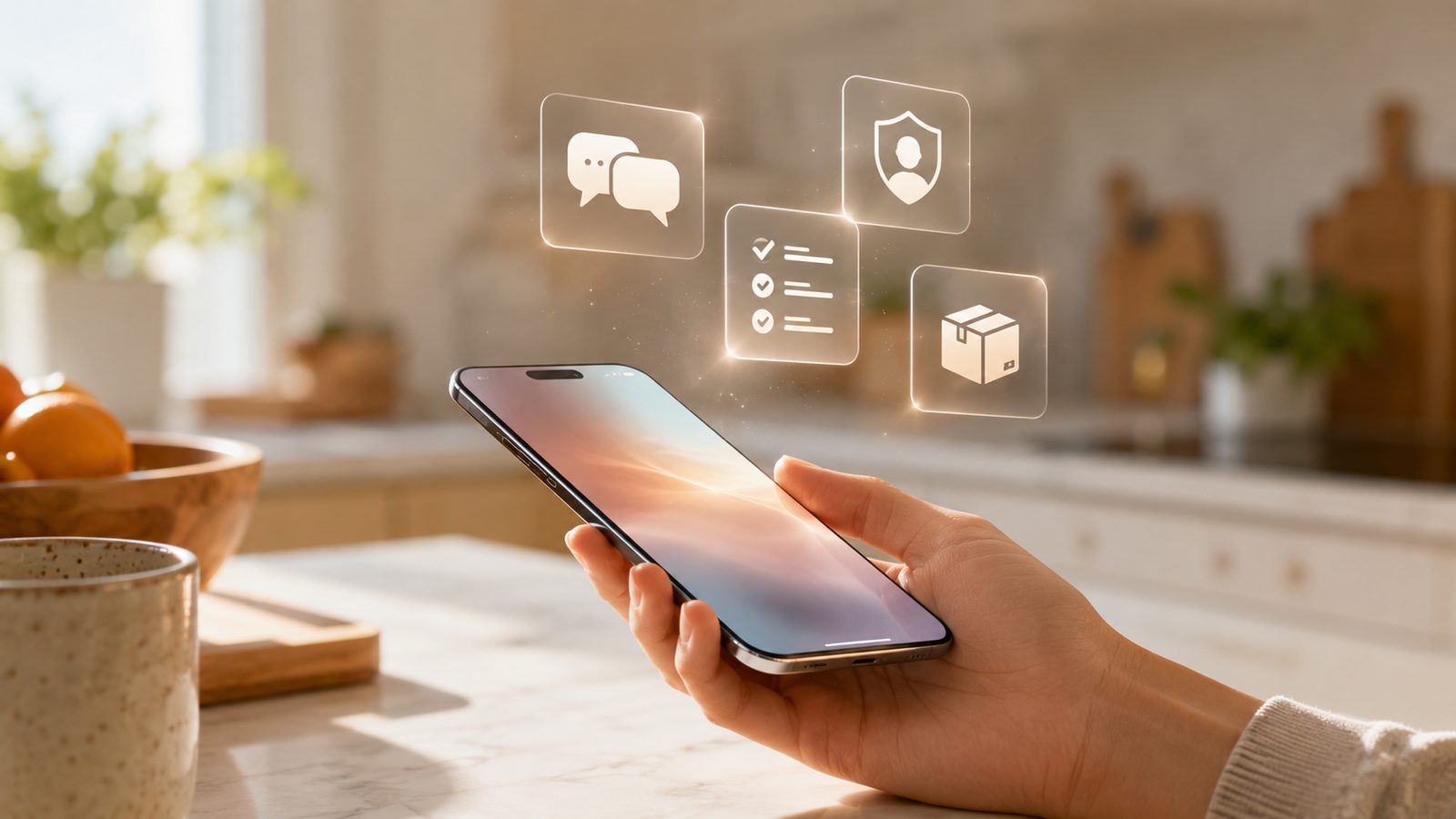
iOS 26, in September 2025, brought a long list of smaller intelligence features that, added up, did more for my ordinary days than the missing headline Siri ever could have. Live Translation turned a language wall in Messages and on a call into a low fence I could step over. Call Screening and Hold Assist took two of the most quietly dehumanizing parts of modern life, the spam call and the hold music, and simply handled them for me. Visual Intelligence let me point at something on my screen and just ask. Apple Wallet started lifting order tracking out of my inbox on its own. Reminders learned to tidy themselves.
None of it made a highlight reel. All of it made a Tuesday softer. And every one of these was a feature Apple could ship without flinching, because it was bounded, ran on the device where it mattered, and did not need to understand my whole life in order to earn its keep. Looking back, iOS 26 was Apple quietly repaying trust in small, honest instalments while it rebuilt the hard thing out of sight. The delayed personal-context abilities finally began slipping out in the 26.4 update this past spring, less a grand return than a door left ajar.
Siri AI, and the assistant we were actually promised
Which brings us here. At its June 2026 developer conference, Apple finally showed the whole picture and gave it a name: Siri AI, a rebuilt assistant that ships with iOS 27. The public beta landed on the thirteenth of July, the real release comes in September, and I have spent enough time with it to feel something I had nearly given up on feeling about Siri: a small, careful hope, this time with evidence underneath it.
Let me stay careful, though, because being careful is the whole moral of this story. iOS 27 is a beta. Siri AI is arriving in pieces, some of it gated behind newer hardware, some of it clearly still finding its feet, some of it waiting behind a queue. I am not going to tell you it is perfect, because it is not, and because the last time I described an unshipped Siri as though I had held it, life corrected me in front of everyone. But I can tell you what it does, because this time the thing is in my hand, not on a slide.
Siri AI can see what is on my screen. When a friend texts about a potluck, I can ask what to bring and watch it drop a recipe into Notes, without my having to explain the situation, because it already read the situation. It reaches, gently, into my own information, my messages, my mail, my photos, my notes, to answer the kind of question that used to make me the search engine. It can act inside apps, editing a message I fired off too fast, adding a song to a playlist mid-sentence, through an expanded developer framework called App Intents. Its answers surface right there in the Dynamic Island and pull down into a full conversation, and it lives in its own app now, its history synced quietly through iCloud, so a thread with it is something I can return to, pin, and carry from my phone to my laptop, instead of a single question swallowed the moment the screen goes dark.
If you have spent a decade saying “no, the other one” to a machine, you will understand why my throat tightened a little the first time it simply understood. Every one of these abilities was on the 2024 wish list. Every one is a thing Siri, for its entire stubborn life, could not do. The difference between the Siri I complained about and the one arriving now is not that it grew a bit cleverer. It is that it finally has the two things any real helper needs. It can see what you are looking at. And it can do something about it.
There is a cost, and the beta makes it plain, so I will say it plainly too. The deepest features want an iPhone 15 Pro or newer, so a lot of people will read about this long before they get to feel it, and that stings in its own small way. And for now, most of Siri’s new depth lives inside Apple’s own apps; the rich third-party support that would let it run a genuine, multi-step errand across the tools you actually lean on is still thin, because Apple retired SiriKit, the scaffolding thousands of apps were built on, in favour of the new App Intents, and their makers are still catching up. The future is here, as the line goes, just not evenly, and not all at once.
Catching up, on Apple’s own terms
Back in 2025 I wrote, a little wearily, that Siri had spent years feeling outdated next to ChatGPT and Google’s assistant. That was me being polite. For most of its life Siri was not a step behind the conversation. It was a decade behind, and we all knew it, and we made our peace with it the way you make peace with a well-meaning relative who never quite listens.
What moves me about iOS 27 is not only that it closes that gap. It is how. Apple did not win by strapping a chatbot to the side of the phone. A chatbot is a room you visit to talk to an AI. What Apple built instead lives in the walls of the house: an assistant threaded through the apps you already use, seeing the screen you are already on, acting where you already are. That is a far harder thing to make, which is part of why it ran so late, and it is also the one shape of this technology a standalone chatbot can never quite copy, because the chatbot does not live where your life actually happens. The wait, I have come to believe, was partly the price of Apple choosing the harder, kinder version of the idea.
And it comes with Apple’s old condition attached, the one I care about most as someone who hands this device the most intimate corners of an ordinary life. The bargain has always been that the assistant is allowed to be personal because the personal part stays on your device, or inside Apple’s private processing, rather than being quietly mined to build a version of you that somebody else can sell. Siri AI leans on that bargain harder than anything before it, because it now touches my messages, my photographs, my mail. If that promise holds under real pressure, and that is a real if that no beta can settle yet, then Apple will have managed the thing the rest of the industry keeps fumbling: an assistant that knows you without an assistant that sells you.
What it actually changes about a day
Strip away the framework names and the keynote music, and what does any of this do for a person just trying to get through a Wednesday?
It gives you back small pieces of your attention. That is the honest heart of it. The old way of using a phone is a string of little errands shaped like apps: open Messages, read the address, copy it, open Maps, paste it, go back, open Notes, type the thing you were asked to bring, hope you remembered it right. The new way folds all of that into a single sentence, because the assistant can see the message, knows the calendar, and can write the note itself. “On-screen awareness” and “personal context” are cold phrases for a warm feeling: no longer having to be the tired connective tissue between your own apps.
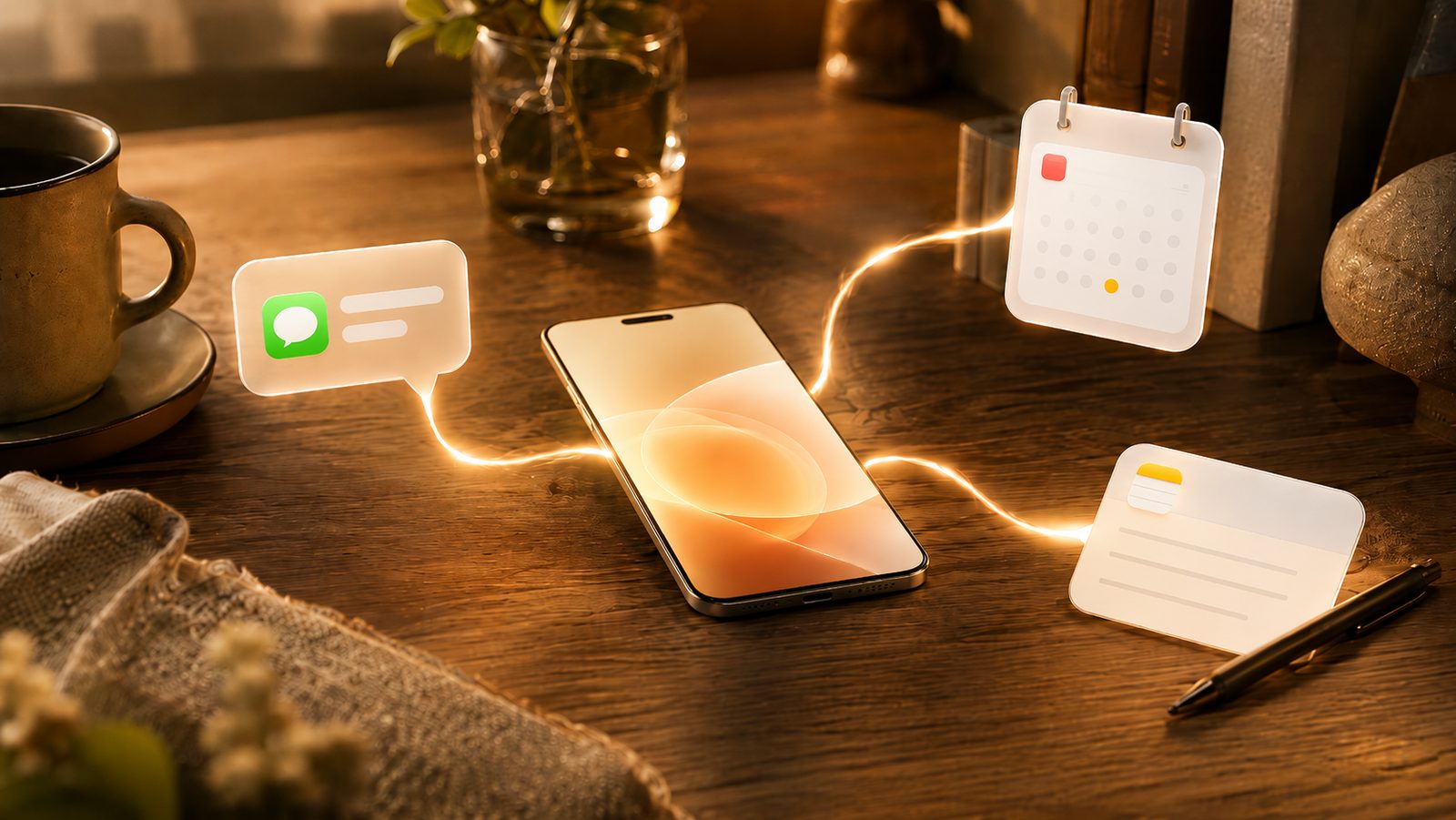
A small thing from my own week, since I promised to keep this honest. A cousin sent one of those long, rambling texts, half plan and half feeling, with a date and a place and a quiet request buried somewhere in the middle. Old Siri could not have touched it. This version read the whole thread, set the date on my calendar, and opened a note with the thing I had been asked to bring, in about the time it takes me to find my glasses. It was not magic, and I did not gasp. I just felt, for a second, quietly looked after by a machine, which is a strange and slightly embarrassing thing to admit, and also true.
That is the version of this technology I have wanted all along. Not the one that dazzles a room. The one that clears the small stuff so I have a little more of myself left over for the large stuff, for the people on the other end of all those messages. It is the same modest promise I fell for in 2024, finally grown to the size of the original dream.
So, was the wait worth it?
I keep circling back to the delay, because I think it is the most misread part of the whole story, and the most human.
At the time it looked like failure, and in the narrow accounting of dates and shipments, it was. Apple missed its window, oversold its hardware, and spent a year absorbing criticism it had earned. But the thing in this beta is better than the thing on that 2024 stage, because Apple went back and rebuilt the foundation instead of shipping the pretty version that only stood up under studio lights. Offered the choice between a Siri that arrived in 2025 and let me down every day, and a Siri that arrived in 2026 and actually works, I will choose the wait every single time. We are not, it turns out, very good at being patient with the things we are rooting for. But patience is sometimes just respect wearing a slower coat.
This is the same stubborn idea I found myself defending a few weeks ago, when I wrote about building software with AI: that a thing deserves to be judged by what it does, not by the story wrapped around it. A demo is a story. A delay is an awkward silence in the story. Neither one is the product. The product is what happens when you ask it, on an unremarkable afternoon, to do an unremarkable thing, and it simply does it. By that measure, and only by that measure, the Siri in iOS 27 is the first version of this idea Apple has earned the right to be proud of, and the first I have felt glad, rather than sheepish, to write about.
I spent two years swinging between hope and doubt over a promise. I would rather spend the next two just living alongside the thing. This beta is not the last word, and I am holding my real verdict until the version that ships in September has survived a few ordinary months, the only test that has ever counted. But it has begun the way none of the earlier versions could: not by promising, but by quietly doing.
And after a decade of “I didn’t quite get that,” that is a genuinely lovely place to have finally arrived.
Sources & References
- Apple Newsroom – Apple introduces Siri AI, a profoundly more capable and personal assistant (June 2026)
- Apple Newsroom – Apple unveils next generation of Apple Intelligence, Siri AI, and more (June 2026)
- TechCrunch – WWDC 2026: Everything announced on Siri AI, iOS 27, Apple Intelligence, and more (June 9, 2026)
- CNBC – Apple delays Siri AI improvements to 2026 (March 7, 2025)
- MacRumors – Apple Plans to Release Delayed Siri Apple Intelligence Features in Spring 2026 (June 12, 2025)
- 9to5Mac – Apple Intelligence has 20+ brand new features in iOS 26, here’s the full list (October 15, 2025)
- AppleInsider – Apple’s upgraded Siri is late but not lost, the real story is timing (February 16, 2026)
- Macworld – iOS 27 Guide: All the new features, release date, and more (2026)