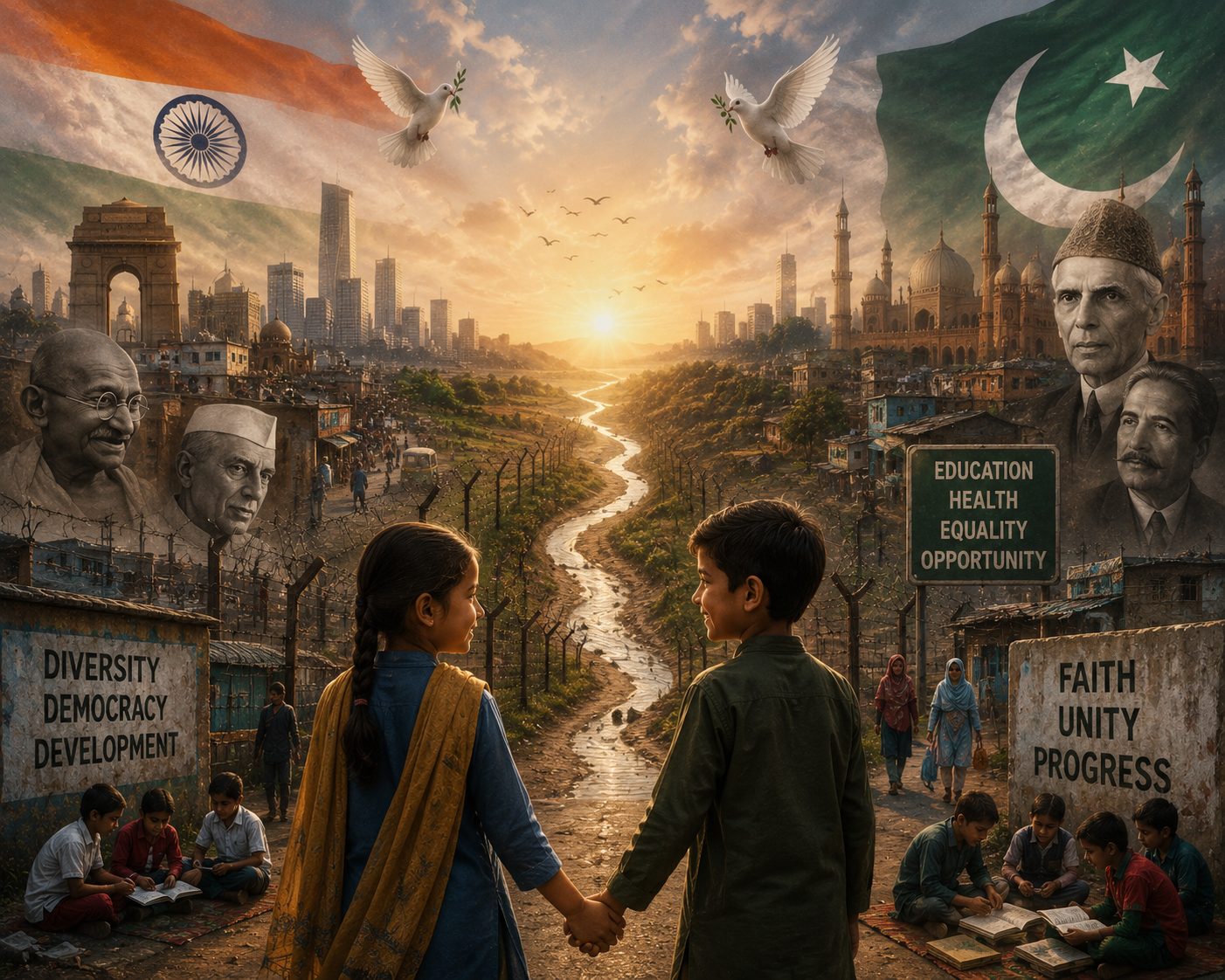
If failure were not an option, what would you dare to dream? For me, it’s crystal clear: I would dream of a world where every child, no matter where they are born, has access to the education they deserve. A world where the digital divide is shattered, and knowledge flows freely to every corner of the globe.
Now, imagine a child in a remote village, sitting before a solar-powered tablet, accessing the same quality education as a child in New York or Paris. This is not a distant fantasy. It’s already happening in parts of the world. But why stop there? Why shouldn’t every child, everywhere, have this chance?
This dream, my dream, is about something bigger: it's about giving the next generation the tools they need to transform their futures and the future of our world. And together, we can make this a reality.
The Transformative Power of Technology in Education
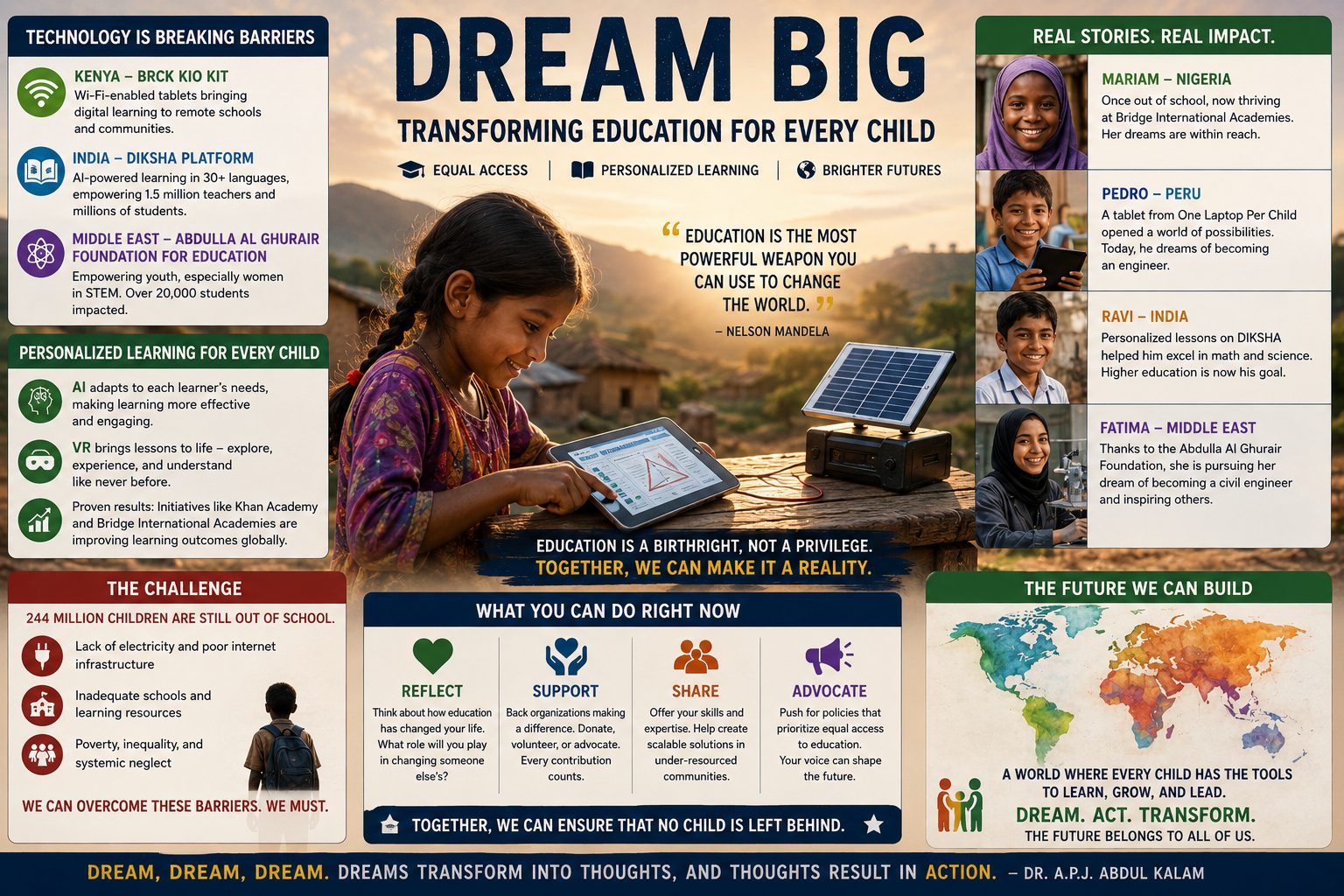
Here’s the truth: Technology has already proven its ability to disrupt barriers. But for the 244 million children still out of school globally, we must do more, now.
In Kenya, the BRCK initiative’s Kio Kit has brought Wi-Fi-enabled tablets to schools in remote areas. For children who had never been online, this was revolutionary. They suddenly had access to an entire universe of knowledge, knowledge that could change their lives forever.
In India, the DIKSHA platform is reshaping how millions of students in underserved areas learn, using artificial intelligence to deliver lessons in over 30 languages. This platform is changing the face of education for 1.5 million teachers and countless students.
And in the Middle East, the Abdulla Al Ghurair Foundation for Education is lifting up young people, especially women, in STEM fields. Already, more than 20,000 students have been empowered by its programs.
These are more than just success stories. They are proof that the path to equal education is within our reach. But now, we need to move beyond small steps. We must think bigger, act faster, and reach every single child.
Personalizing Learning: Education for Every Individual
The one-size-fits-all approach to education doesn’t work. Every child learns differently, and every child deserves lessons tailored to their needs.
With AI-driven platforms and virtual reality, we can bring the world’s knowledge into any classroom, whether that’s in an urban city or a remote village. Imagine learning math by stepping inside an equation, or studying ancient history by walking through a virtual Roman forum. The possibilities are limitless.
Khan Academy is already harnessing the power of personalized learning for millions. And in Bridge International Academies, data-driven lessons have boosted educational outcomes in some of the most underserved parts of Africa. These initiatives prove that technology can meet students where they are and help them achieve more than ever imagined.
We’ve seen what’s possible. But what if every child had these opportunities? What if every child, from the deserts of Africa to the mountains of Nepal, could access lessons built just for them?
Education Is a Birthright, Not a Privilege
This isn’t about charity. It’s about justice.
Education is a birthright, not a privilege reserved for the lucky few. Every child, regardless of where they come from, deserves the opportunity to learn. As Nelson Mandela said, “Education is the most powerful weapon you can use to change the world.”
But the weapon remains locked away from millions. Children are being robbed of their future because of where they live, their family’s income, or circumstances beyond their control. That’s not just a failure. It’s an injustice.
When my wife and I moved to Toronto, it was education that opened the door to a new world for us. It wasn’t just an academic journey; it was the key to opportunity, growth, and belonging. Every child deserves that same chance.
Think about your own journey. How has education changed your life? What doors has it opened? Now imagine if that door had never been there for you. That’s the reality for millions of children today.
Real Stories of Transformation
These are not just abstract ideas. This is happening right now. In the hands of children like Mariam, Pedro, Ravi, and Fatima, education has already begun transforming lives:
- Mariam, a 10-year-old in Nigeria, had never stepped into a classroom before joining Bridge International Academies. Now, she’s thriving, her confidence soaring, her dreams within reach.
- Pedro, a 12-year-old in Peru, received a tablet through the One Laptop Per Child initiative. That small piece of technology opened the door to a world of possibilities. Today, he’s on the path to becoming an engineer.
- Ravi, a young boy from India, was once struggling to grasp basic concepts. But through personalized lessons on the DIKSHA platform, he excelled in mathematics and science. Now, higher education is within his sights.
- Fatima, from the Middle East, broke through cultural and financial barriers thanks to the Abdulla Al Ghurair Foundation for Education. She’s now pursuing her dream of becoming a civil engineer, a role model for young women in STEM across the region.
These stories are living proof of what happens when we break down the walls that stand between children and education. But for every child like Mariam, Pedro, Ravi, and Fatima, there are millions more waiting. We cannot stop now.
The Urgency of Action
Let’s not pretend that technology alone will solve all our problems. There are real challenges: lack of electricity, poor internet infrastructure, and government indifference in many regions. Critics argue that education cannot rely on gadgets, and they’re right: teachers, schools, and community support remain crucial. But technology is the key that can unlock the door.
The time for small-scale solutions is over. This is a call to scale up, to dream bigger, and to demand more. Together, we can overcome these barriers. The future of millions of children depends on it.
What You Can Do Right Now
This is not someone else’s problem. It’s ours. Here’s how you can act.
Reflect on the role education has played in your own life, and consider what it would take to ensure that every child has access to the same opportunities you did. Then back the organizations doing this work, such as One Laptop Per Child, BRCK, Bridge International Academies, and the Abdulla Al Ghurair Foundation for Education, by donating, volunteering, or advocating for them.
If you’re a teacher, technologist, or someone who believes in the power of education, you can also offer your skills to create scalable solutions in under-resourced areas, whether through curriculum development, technical expertise, or mentorship. And you can push your local governments to invest in educational technology and to prioritize equal access to education. Your voice can change the future of millions of children.
This Dream Requires Action
Dr. A.P.J. Abdul Kalam once said, “Dream, dream, dream. Dreams transform into thoughts, and thoughts result in action.” The dream of universal, personalized education is not a fantasy. It’s within our grasp. But dreams are not enough; action is what will turn this vision into reality.
So I keep returning to the question I began with: if failure weren’t an option, what would you do to change the future of education? For me, the answer is to keep believing that every child, everywhere, deserves the chance to learn, and to do what I can to help make that true.